When corrosion, erosion or hidden material loss affects a critical asset, the risk is not always visible from the outside. A pipe, tank, pressure vessel or structural component may look sound, while the remaining wall thickness beneath the surface has reduced over time.
A reliable ultrasonic thickness gauge helps inspection teams check material thickness without cutting into the asset, removing it from service or accessing both sides. For safety-critical environments, the question is not only “how thick is the material?” but “is there enough remaining wall thickness for continued safe use?”
Coltraco Ultrasonics supplies the Portagauge® 6, a UK-made multi-echo ultrasonic thickness gauge designed for accurate wall thickness measurement, corrosion inspection and non-destructive testing across industrial and marine applications.


We are proud winners of the Queen’s Award for Enterprise in International Trade, in both 2019 and 2022.
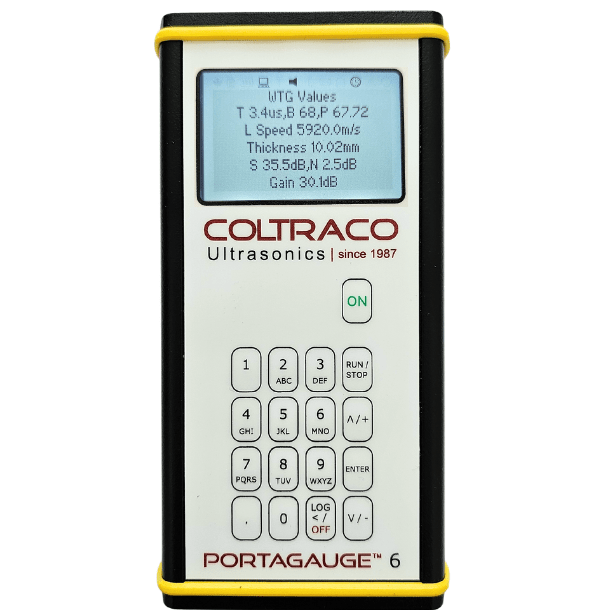
An ultrasonic thickness gauge measures material thickness by sending a sound wave through the measured surface and timing how long the reflected wave takes to return. The gauge uses this time interval and the sound velocity of the material to calculate thickness. This allows inspectors to carry out wall thickness measurement from one side of the test piece without cutting, drilling or damaging the asset.
In everyday terms, the probe is placed on the surface of the material, and the gauge provides a thickness reading based on how the ultrasonic pulse travels through it.
Ultrasonic thickness measurement relies on sound travelling through different materials at known speeds.
The gauge sends an ultrasound wave into the material through a probe or transducer. When the wave reaches the back wall of the material, it reflects back towards the probe. The gauge measures the time interval between the transmitted ultrasonic pulse and the reflected wave, then calculates the material thickness.
For accurate measurements, the following points matter:
The Portagauge® 6 includes a built-in material database for common materials, helping users measure different materials more consistently.
Not all ultrasonic thickness gauges work in the same way.
A single-echo gauge usually measures the time between the first ultrasonic pulse and the first reflected wave. This can be suitable for some clean, uncoated materials, but it may be less practical where protective coatings or paint are present.
A multi-echo ultrasonic thickness gauge uses multiple reflected echoes to help determine the true material thickness beneath the coating. This is where the Portagauge® 6 is especially useful. It can ignore coatings up to 20mm thick, helping users focus on the material thickness rather than the coating thickness.
This is important because the purpose of the Portagauge® 6 is not to act as a paint thickness or coating thickness gauge. Its role is to measure the remaining wall thickness of the material underneath.
Wall thickness measurement is closely linked to safety, maintenance planning and asset reliability.
When corrosion or erosion reduces wall thickness, the affected asset may become more likely to leak, weaken or fail. This is especially important for assets under pressure, exposed to harsh environments or used in fire safety, marine or industrial systems.
Accurate ultrasonic thickness measurement can help teams:
For example, an engineer checking steel pipework can compare current readings against the expected wall thickness. If measurements fall below an agreed threshold, the asset can be flagged for repair, closer monitoring or replacement.
The Portagauge® 6 is suited to users who need a practical wall thickness gauge for industrial inspection, especially where surfaces are coated, painted or difficult to access.
It may be the right ultrasonic thickness gauge for your application if:
If your site has unusual materials, coatings, access limitations or inspection conditions, Coltraco can advise whether the Portagauge® 6 is suitable.
In many working environments, removing paint or protective coatings before testing is not practical. It can add time, increase cost and expose the material to further corrosion.
The Portagauge® 6 is designed to measure through coatings up to 20mm thick. This helps users obtain true material thickness readings without stripping the surface first.
This is particularly useful for:
For many inspection teams, this is one of the key reasons to choose a multi-echo ultrasonic thickness gauge over a basic digital thickness gauge.
Ultrasonic thickness gauges are used across many industries where material thickness needs to be checked without destructive testing.
In marine environments, corrosion and coating systems are constant considerations. Ultrasonic wall thickness measurement is often used for hulls, structures and coated steelwork.
A multi-echo gauge is well suited to these applications because it can support accurate measurements through protective coatings.
Pipework in fire suppression systems can deteriorate over time. Ultrasonic thickness measurement helps engineers check pipe condition without cutting into the system. This supports better maintenance planning and helps identify areas where further inspection may be required.
In industrial applications, pipework, storage tanks and pressure vessels may be exposed to moisture, temperature changes, chemicals or abrasive materials.
Using an ultrasonic thickness gauge helps inspection teams monitor material loss and check whether critical assets remain suitable for continued operation.
Thickness measurement is also used in quality control, where manufacturers need to check material thickness against expected tolerances.
Digital thickness gauges with data storage can help teams record readings, review inspection data and maintain evidence for internal standards or customer requirements.
Choosing the right ultrasonic thickness gauge depends on the asset, the material and the inspection environment.
Before choosing a gauge, consider:
For coating-ignoring wall thickness measurement, a multi-echo instrument such as the Portagauge® 6 is often a better fit than a basic gauge.
You can view Coltraco’s ultrasonic thickness gauge equipment or explore the Portagauge® 6 ultrasonic thickness gauge for more detailed product information.
Coltraco Ultrasonics is a British manufacturer of ultrasonic and acoustic technology for safety-critical environments. Its instruments are designed to help users inspect, measure and verify assets with confidence.
The Portagauge® 6 has been developed for ultrasonic testing and wall thickness measurement where accuracy, usability and practical inspection features matter.
Key features include:
If you need to check pipework, storage tanks, pressure vessels, marine structures or coated surfaces, Coltraco can help you decide whether the Portagauge® 6 is right for your application.
Share details of your asset, material type, coating condition, measurement range and working environment, and the Coltraco Ultrasonics team can provide practical guidance.
Contact Coltraco today to discuss your inspection requirements, request a quotation or find the right ultrasonic equipment for your site, vessel or facility.