
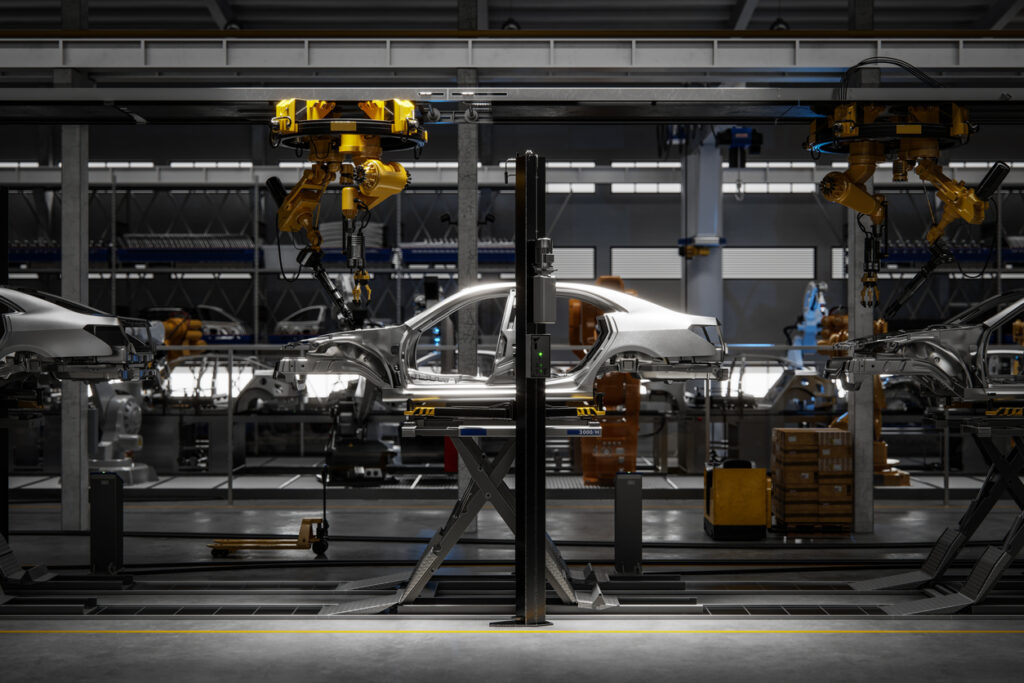
In recent years, airtightness testing for final body assembly in car manufacturing has had to be rethought. With the introduction of new net-zero goals for manufacturing, managing water consumption accompanied by a push to manufacture EV cars has made the traditional water spray method for car airtightness unsuitable; it is wasteful with water and incompatible with EV manufacturing as well as being labour intensive and time consuming.
Since the turn of the decade, alternative methods to test the tightness of a vehicle body, known as dry testing, have slowly been introduced to car manufacturing all over the globe. These methods can vary between, helium tracers, smoke pencils, pressure decay, or acoustic/ultrasonic technology. But with so much choice how can a manufacturer know which method is right for assembly lines?
Here at Coltraco, we have nearly 40-year heritage of researching and manufacturing ultrasonic technologies so, we recognise the advantage of Ultrasonic equipment for leak testing over all other methods.
Ultrasonic devices can locate a leak with ease, it does not use any combustibles, like Helium tracers and smoke pencils, and is quick and easy to use with possible automation compatibility. There is no need for pressurisation or temperature control and is not impacted by external factors like noise, heat or activity, which is typically found in a manufacturing working environment.
Therefore, ultrasonic equipment is capable of replacing old water spray testing or work alongside other methods of dry testing to strengthen their accuracy. Our ultrasonic technology can tell you where a leak is and how big it is, allowing for faster maintenance times and much more effective traceability in data-logging.
It even holds an advantage over Acoustic technologies. The acoustic instruments camera/array picks up airborne ultrasonic emission from a distance. This means the non-contact camera struggles with line-of sight/distance in cramped assembly stations as well as being affected by noise. In the case of Ultrasonic technologies, the transmitter is placed in a cabin, and the sensor is used to scan the seals at a close range. Therefore, there is no requirement for pressurisation, or interference from background noise.
Why Coltraco?
At Coltraco, we have our own engineering services and research institute (DIRDI), allowing us to be a leading British research-to-manufacturing organisation which produces high quality dual acoustic and ultrasonic instruments to solve industry problems.
Our vision is to be a leader for the automotive industry in precision air tightness testing using ultrasonics, setting the standard in ease of integration, and redefining quality control for leak defects.
Alongside our heritage and expertise supplying our technologies with heavy industries, we have had the amazing opportunity to partner with a few automotive companies in researching and developing bespoke dry test systems, inspired from our existing airtightness product, which can be fully ultrasonic or integrated alongside other methods. Our work to date has demonstrated the ease of assembly line integration including robotics and step changes in production airtightness testing.
If you would like to find out more or if you are interested in partnering with us to implement ultrasonic technologies for your company’s manufacturing lines, do not hesitate to get in contact with us at [email protected] to organise a short call with our friendly R&D team.