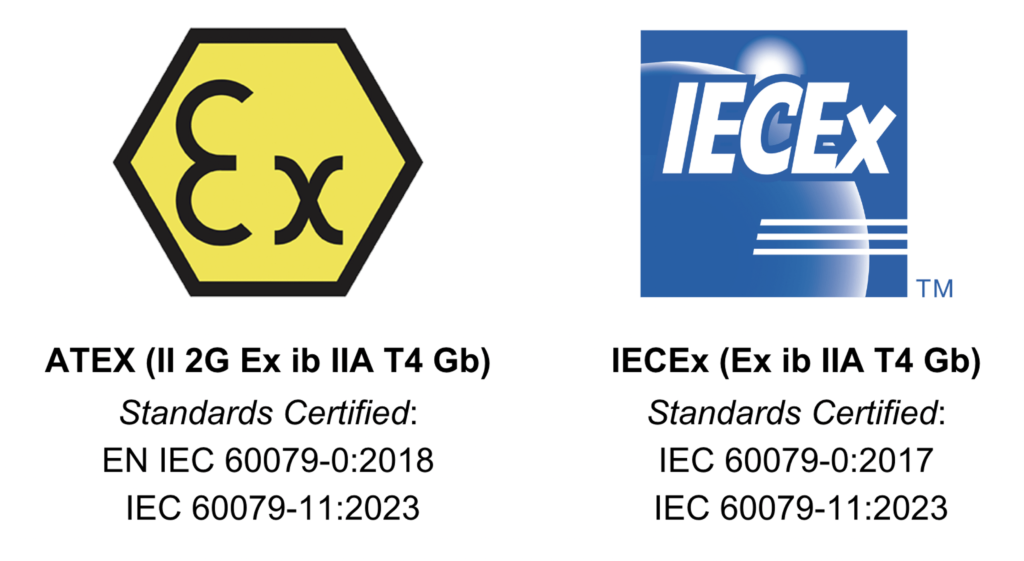
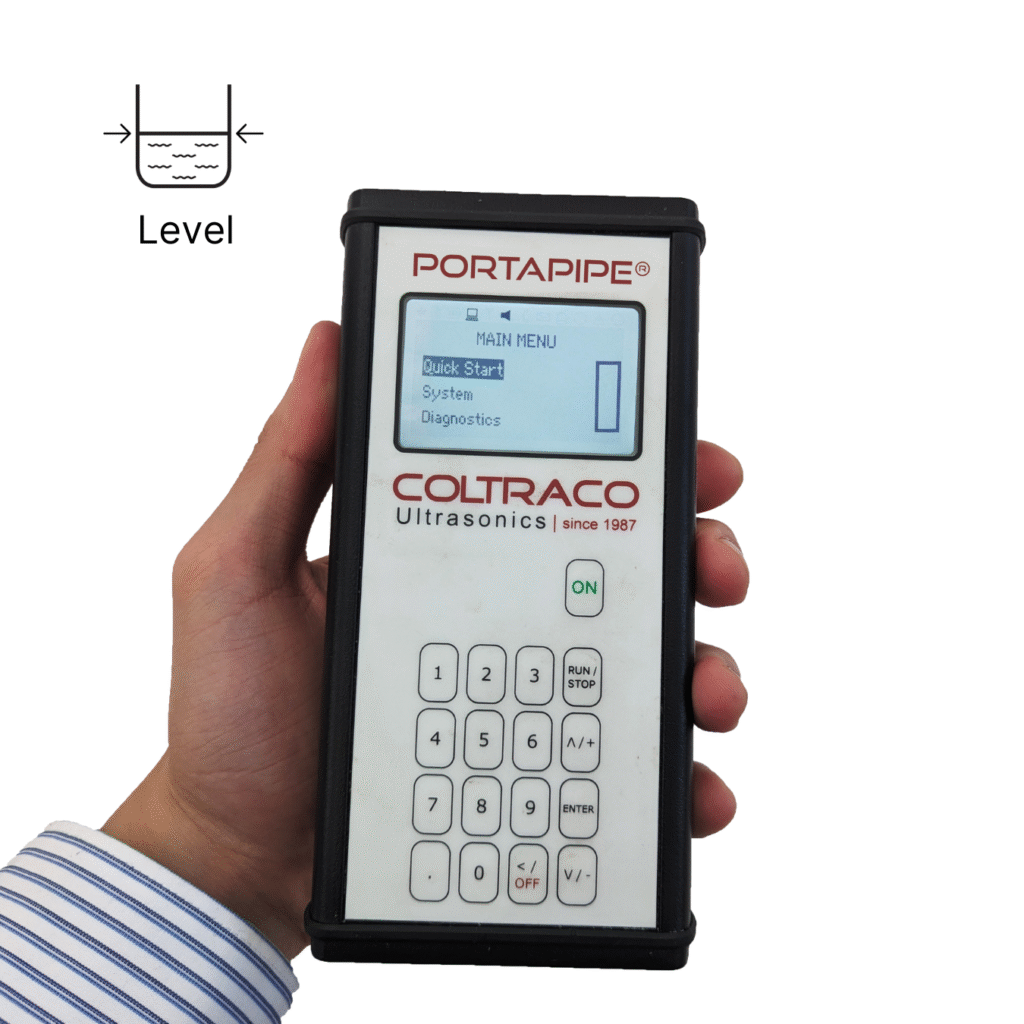
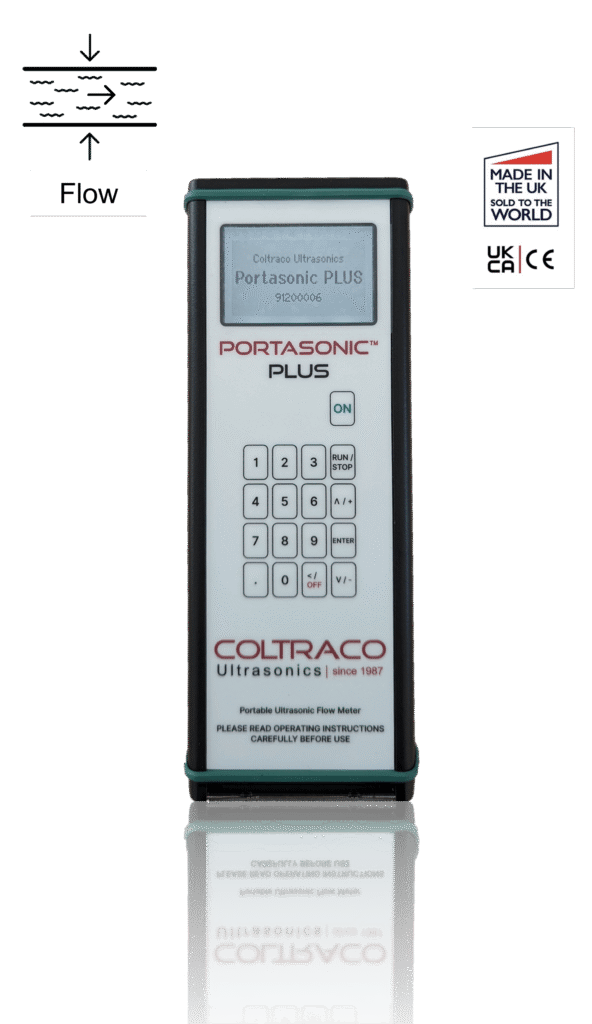
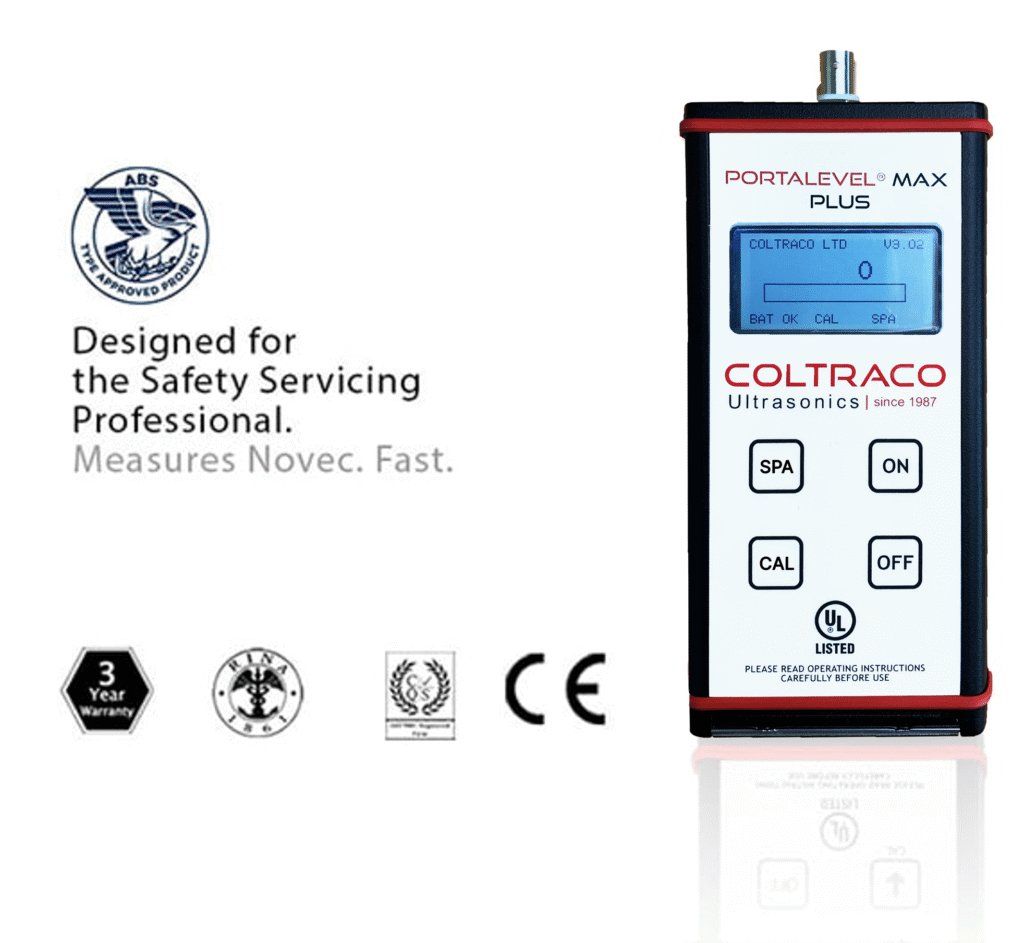
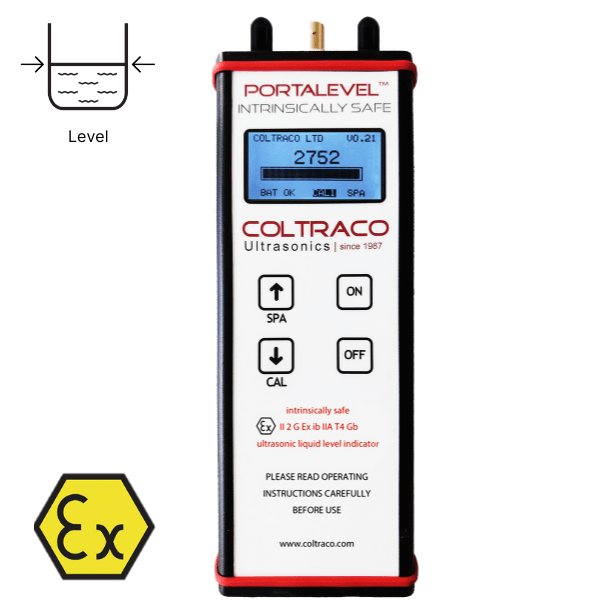
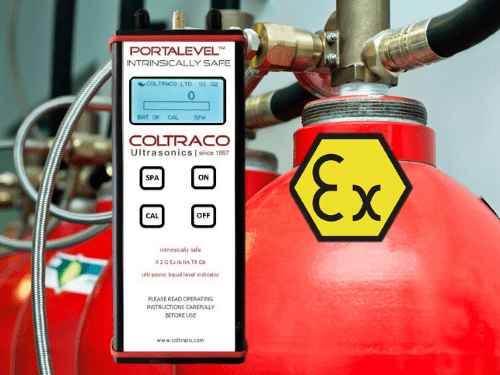
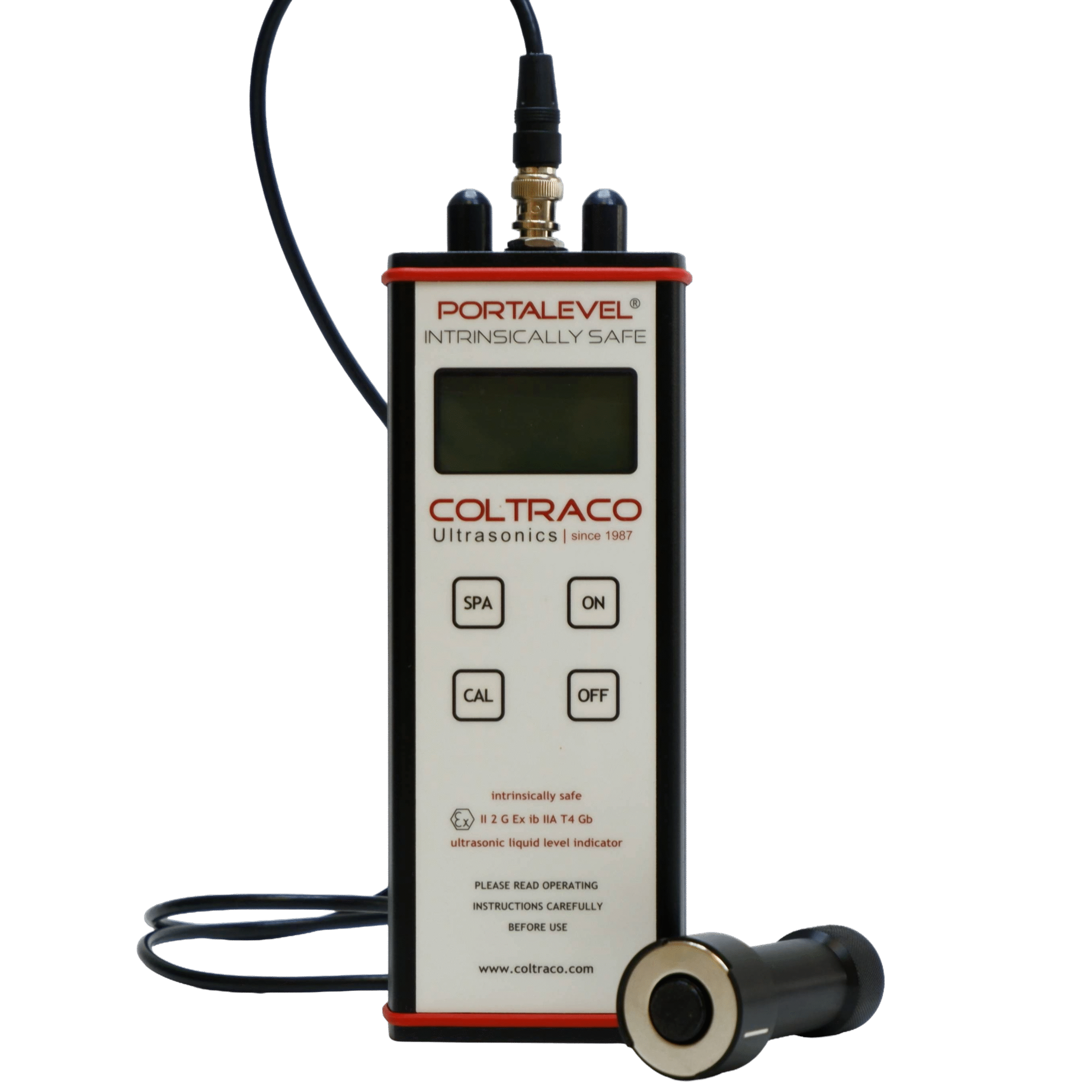
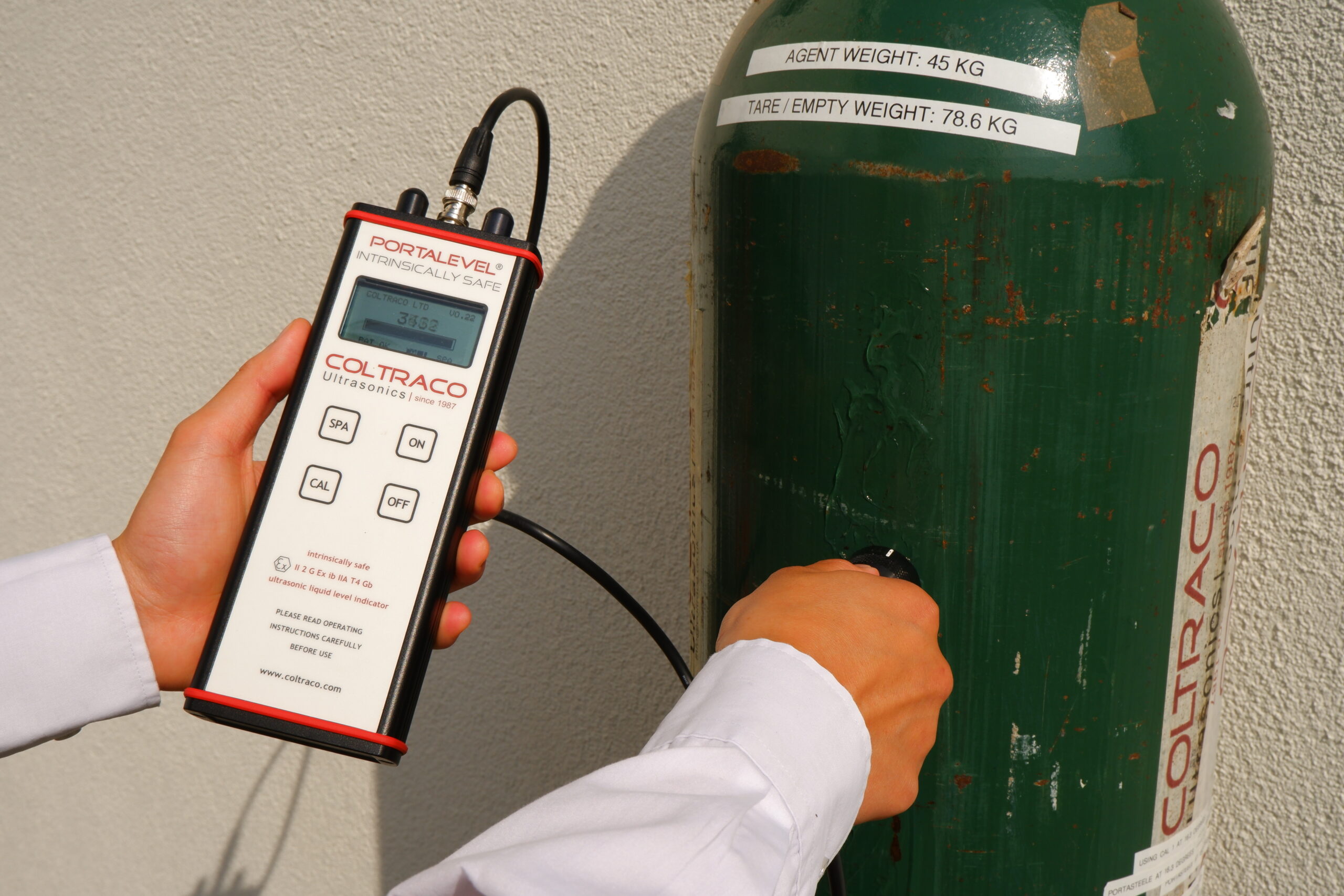
The Portalevel® INTRINSICALLY SAFE is an ultrasonic liquid level indicator approved for Zone 1 and Zone 2 ATEX and IECEx hazardous or explosive environments.
P/N: 2290334-IS
CAGE Code: KD983 – COLTRACO LIMITED
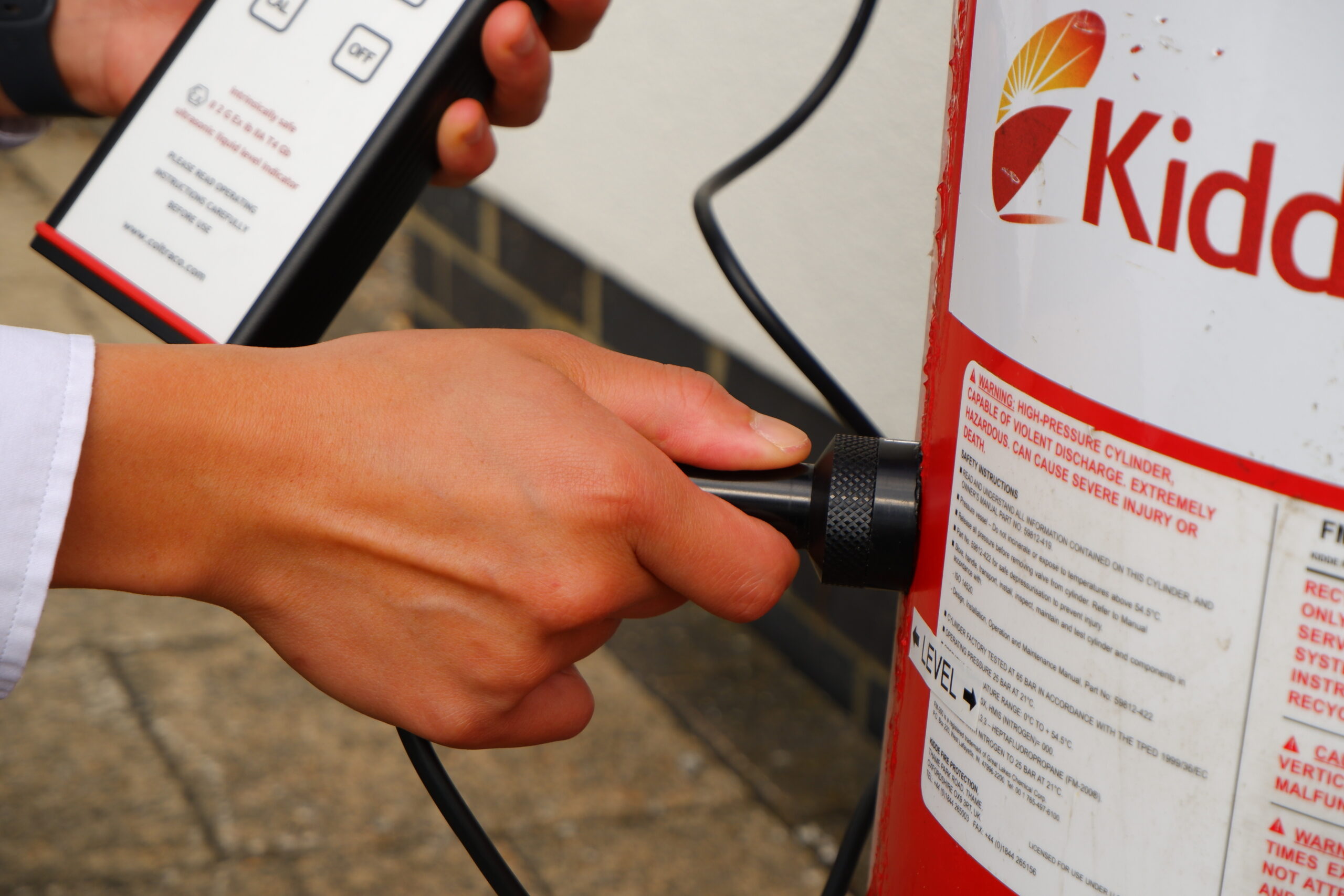
The Portalevel® INTRINSICALLY SAFE is a specialist, intrinsically safe ultrasonic liquid level indicator. It is designed for non-invasively monitoring the contents of fire suppression systems in hazardous, explosive environments. This device is the ideal tool for testing cylinder contents in ATEX Zone 1 and Zone 2 hazardous classified areas.
Intrinsically Safe Ultrasonic Level Indicators
In order to meet ATEX requirements for power output, the Portalevel® INTRINSICALLY SAFE outputs a much weaker signal than our Portalevel® MAX range. To adapt to this, we developed and adapted our calibration algorithms to offer three “modes” of calibration, including an intelligent calibration mode (iCal).
The Portalevel® INTRINSICALLY SAFE also has four different power settings, for larger or more corroded cylinders. This, in combination with the three calibration options, allows the unit to be used on a wide variety of cylinder types and agents, with minimal user input. This was critical in allowing us to maintain our high standards of accuracy (±1.5mm of the true level) and ease of use in a handheld, ATEX Zone 1 approved package.
Designed with safety in mind, the Portalevel® INTRINSICALLY SAFE is perfect for areas where volatile or explosive gases, vapours or mists are likely to be present in the air (IECEx Zone 1), such as:
Converting Liquid Level to Weight
Monitoring the liquid level in fire cylinders is a vital aspect of any fire suppression system maintenance schedule, however, understanding how the liquid level relates to the fill weight of the cylinder is equally important. Coltraco Ultrasonics offer, in conjunction with the Portalevel® range, the world’s first liquid level to agent mass calculator.
The Portasteele® CALCULATOR calculates the agent weight of a fire suppression cylinder. It does this by using the liquid level determined by our Portalevel® range or inversely, by using the required fill level for a certain weight of suppression agent. The Portasteele® CALCULATOR is sold as a stand-alone unit on a 7’’ hand-held tablet to be used in conjunction with our Portalevel® range.
| Dimensions |
|
| Sensor |
|
| Accuracy | ± 1.5mm or ± 1/16 inch of the true level |
| Power Supply | 215mm (L) x 82mm (W) x 30mm (D) |
| Display | 4 x Energizer L91 AA Batteries
|
| ATEX Rating | II 2 G Ex ib IIA T4 Gb |
| Operating Temperature | –20°C to +40°C / -4F to 104F |
| Warranty |
|
The use of water or an ultrasonic coupling gel is essential to the operation of a Portalevel® unit. This is because the sensor emits a high energy pulse of ultrasound, which must travel through the cylinder so that the sensor can then detect the returning echoes. However, if there is not a perfect contact between sensor and cylinder, the signal will be reflected from the surface of the cylinder and will not be detected. Applying a thin layer of gel, or a small amount of water, to the cylinder, ensures that this perfect contact is achieved and that the sensor is reliably coupled to the sensor for the duration of the test.
Some cylinders, particularly large or heavily rusted/corroded cylinders, can present problems, even with perfect coupling between sensor and cylinder. This can also occur if the liquid inside the cylinder attenuates the ultrasound signal particularly strongly so that the returning echo is too weak. In these situations, users may engage the Special Power Application (SPA), to boost the output power of the Portalevel® and increase the signal strength.
The digital readings on the Portalevel® INTRINSICALLY SAFE display represent the strength of the returning echoes. The Portalevel® INTRINSICALLY SAFE can then be calibrated to an area of higher readings, which will cause the bar graph on the display to completely fill. The sensor can then be gradually moved towards lower readings until the bar graph disappears. The point that this occurs is the liquid level.
For some liquids at certain pressures, it is vital that liquid level testing is done at temperatures below what is known as their “critical temperature”. The critical temperature is the temperature at which, above some “critical pressure”, a liquid will transform from its normal liquid state into a new state known as a “supercritical fluid”. At this point, there will be no distinct liquid and gas phase and so there will be no identifiable liquid level. For most substances, this critical temperature is outside of regular operating temperatures (e.g., NOVEC™ 1230 has a critical temperature of over 150ᵒC). CO2 and FE-13™, however, have their critical points at 31ᵒC and 26ᵒC, respectively. If a cylinder containing either of these agents is at a higher temperature than this, the cylinder must be cooled down before a liquid level test can be conducted. This can be done with AC units, running water over the cylinder or using ice packs around the cylinder.