
Accurate flow velocity measurement helps engineers understand how quickly liquid is moving through a pipe without relying on assumptions about system performance. In water supply, building services, power generation and industrial process systems, dependable flow measurements can support commissioning, maintenance, efficiency checks and fault diagnosis.
Coltraco Ultrasonics develops non-invasive ultrasonic technologies for critical systems. Its clamp-on ultrasonic flow meter range allows engineers to measure flow through compatible pipework from the outside, avoiding the need to cut into the pipe or install an intrusive flow sensor for temporary testing.
For suitable liquid applications, ultrasonic flow measurement provides a practical way to assess flow velocity, volumetric flow and mass flow while reducing disruption. The operating principle is based on ultrasonic pulses travelling through the pipe and fluid. By comparing the travel time of signals moving with and against the direction of flow, the instrument can determine velocity and calculate flow rate.
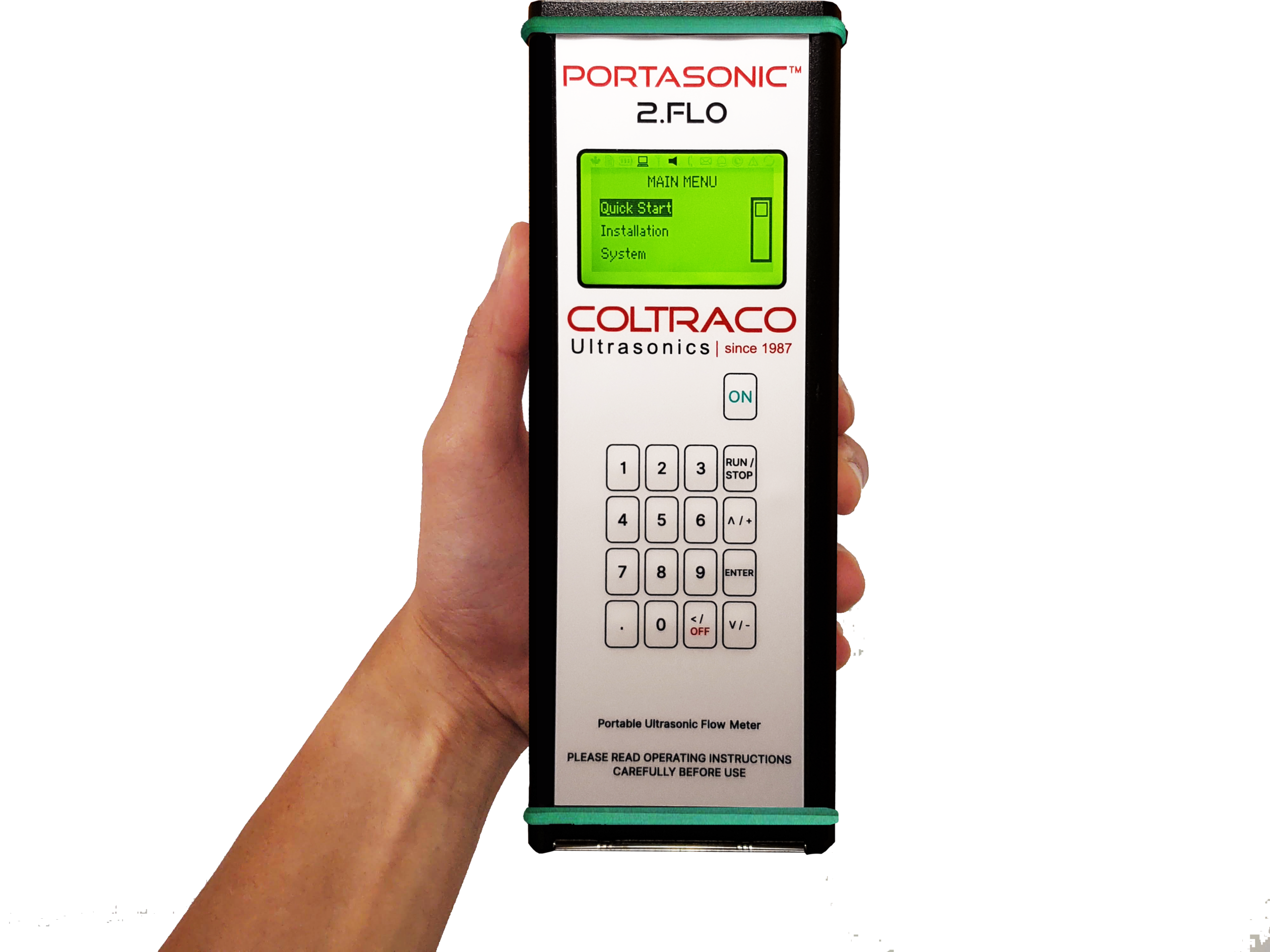
In pic: Portasonic® 2.FL0, Main Unit in Hand.
What is flow velocity?
Flow velocity describes the speed at which a fluid travels through a pipe, channel or other defined passage. It is normally expressed as distance per unit time, such as metres per second.
Velocity measurement is different from flow rate measurement. Velocity tells you how fast the fluid is moving, while flow rate tells you how much fluid passes a point during a given unit time. Both are closely linked, which is why a flow meter can use velocity to calculate the volume moving through a known pipe.
The relationship is:
Q = A × v
Where:
- Q = volumetric flow rate
- A = cross sectional area
- v = average velocity
If the cross sectional area of the pipe is known and the meter can determine average velocity, volumetric flow can be calculated. Volumetric flow may be shown in litres per second, litres per minute, cubic metres per hour or cubic meters per second, depending on the application.
Average velocity matters because fluid does not move at exactly the same speed across the entire cross section of a pipe. Friction affects the liquid close to the pipe wall, while flow nearer the centre can move faster. Local velocity measurements can be useful in research or specialist testing, but industrial fluid flow measurement normally requires a representative average velocity rather than a reading from one point alone.

What is the difference between flow velocity and flow rate?
Flow velocity and flow rate describe different aspects of the same fluid flow.
Imagine two pipes carrying water at the same velocity. If one pipe has a larger cross sectional area, it can carry a greater volume during the same period. In the same way, two systems can have the same flow rate while operating at different velocities if the pipe diameters are different.
This distinction is important when selecting the right flow meter. A technician may need to measure water volume through a branch line, check whether a system is delivering the expected flow rate or compare velocity before and after an operational change.
Volumetric flow meters focus on the amount of volume passing a point per unit time. Mass flow describes the amount of mass passing that point in a given period. Where fluid density is known and reasonably stable, mass flow can be derived from volumetric flow. This allows an instrument to measure volume and calculate or measure mass for process reporting.
For gas, density can vary significantly with pressure and temperature. That is why gas industries, including natural gas applications, may require additional pressure, temperature and composition compensation. These applications are useful context for understanding flow science, although Coltraco’s strongest relevance here is non-invasive liquid flow measurement.
How does ultrasound measure flow velocity?
Transit-time ultrasonic flow measurement uses paired transducers attached to the outside of a pipe. Each can act as a transmitter and receiver.
One set of ultrasonic pulses travels downstream with the fluid flow, while another travels upstream against it. The downstream signal arrives slightly sooner because it is travelling with the movement of the liquid. The upstream signal takes slightly longer.
The difference between those travel times is directly proportional to the velocity of the fluid along the acoustic path. Using that difference together with information about the pipe and liquid, the flow meter can calculate flow velocity and flow rate.
This means the instrument can take flow measurements without placing a mechanical component in the fluid path. For suitable pipework and liquids, this can reduce installation work and avoid the additional pressure drop that can be created by intrusive meter designs.
Transit-time and Doppler ultrasonic flow measurement
There are two main types of ultrasonic flow measurement commonly discussed: transit-time and Doppler.
Transit-time measurement compares the travel time of ultrasonic signals moving upstream and downstream. It is generally suited to liquids that provide a clear ultrasonic path.
Doppler measurement works differently. It uses a change in signal frequency caused by particles, bubbles or other reflectors moving with the fluid. The most appropriate method depends on the fluid, pipe conditions, expected flow range and purpose of the measurement.
For Coltraco’s Portasonic® PLUS, the relevant operating principle is transit-time ultrasonic measurement.
Why use non-invasive flow velocity measurement?
Traditional meter installation may require pipe modification, isolation, inline fittings or a period of shutdown. For a permanent process installation, that may be acceptable. For inspection, commissioning, verification or fault-finding, it can create unnecessary disruption.
A clamp-on flow meter attaches to the outside of compatible pipework. This allows technicians to measure flow without opening the line or introducing another component into the fluid.
Key benefits can include:
- No need to cut into compatible pipework for temporary testing
- No added obstruction in the flow path
- Reduced risk of an additional pressure drop caused by an intrusive restriction
- Portable measurement across multiple suitable locations
- The ability to measure flow velocity and volumetric flow during inspection or troubleshooting
- Less disruption to systems where shutdown would be costly or inconvenient
A non-invasive method does not remove the need for correct installation. Measurement accuracy still depends on the instrument, pipe information, fluid properties, sensor placement and the quality of the ultrasonic signal.
How do you measure flow velocity with a clamp-on flow meter?
Taking velocity measurements with an ultrasonic clamp-on meter requires accurate pipe and fluid information.
The exact process should always follow the relevant product instructions, but a typical workflow includes:
- Enter the pipe material, outside diameter and wall thickness.
- Select the fluid and confirm the expected operating conditions.
- Choose the appropriate sensor arrangement for the pipe diameter and expected flow range.
- Prepare the pipe surface and apply suitable acoustic couplant.
- Position and secure the sensors at the required spacing.
- Check signal quality and diagnostic information.
- Allow the reading to stabilise before recording velocity, volumetric flow, mass flow or another required value.
Correct setup is important because the meter relies on small differences in ultrasonic travel time. Poor coupling, air gaps, unsuitable sensor placement or incorrect pipe data can reduce accuracy.
The surrounding pipe layout also matters. Bends, pumps and valves can disturb the velocity profile, while a suitable straight pipe section can help provide a more stable measurement. Low flow rates may be more difficult to resolve because the difference between upstream and downstream travel times becomes smaller.
Laminar flow and turbulent flow also create different velocity profiles. The meter needs suitable conditions to calculate average velocity reliably, so the measurement location should be chosen with the process and pipe layout in mind.
What affects ultrasonic flow measurement accuracy?
Several factors influence measurement accuracy in practical fluid flow measurement.
Pipe data and condition
Incorrect pipe diameter, wall thickness, lining or material information can affect the calculation even if the ultrasonic signal appears strong. The pipe surface must also allow suitable coupling between the sensors and pipe wall.
Fluid properties
Transit-time measurement works best when ultrasonic pulses can travel clearly through the liquid. Heavy aeration, unsuitable concentrations of suspended material or other difficult conditions can weaken the signal.
Flow profile
A disturbed flow profile can make average velocity harder to determine. Pumps, valves, bends and changes in pipe diameter close to the measurement point may affect the result.
Flow range
Every flow sensor is designed to operate within a suitable flow range. Very low flow rates can produce small timing differences, while very high velocity can place greater demands on sensor positioning and signal quality.
Calibration and setup
Flowmeter calibration provides confidence in instrument performance, but calibration cannot compensate for poor installation or incorrect site data. Good measurement practice combines calibrated equipment with appropriate setup, suitable test conditions and correct interpretation of the result.
How Portasonic® PLUS measures liquid flow
For portable non-invasive measurement, Coltraco offers Portasonic® PLUS, a handheld ultrasonic transit-time flow meter designed to measure, record and export flow data from suitable liquid pipework.
The sensors clamp to the outside of the pipe, allowing engineers to measure flow without interrupting the process. This makes the instrument relevant to water utilities, building services, industrial sites, marine applications, power systems and fluids handling environments where temporary or portable testing is useful.
Portasonic® PLUS measures flow velocity across a stated range of 0.01 m/s to 25 m/s and has a stated flow-rate accuracy of ±0.5% under the published product specification. Depending on the sensors used, current product information covers pipe sizes from DN15 up to DN2500.
The meter can provide several useful outputs, including:
- Flow velocity
- Volumetric flow rate
- Mass flow rate
- Energy or heat flow rate
- Volume
- Mass
- Energy
This means the same underlying velocity measurement can support different engineering questions. A technician may need to measure water delivery, compare volumetric flow across parts of a system, measure mass for a process calculation or assess heat transfer where flow rate and temperature difference are both relevant.
ISO 17025 calibration certification can also be specified where the application requires additional calibration documentation.
Where is flow velocity measurement used?
Non-invasive ultrasonic flow measurement is relevant anywhere engineers need reliable information about liquid movement without unnecessarily disturbing the system.
Water supply and water utilities
In water supply networks, a portable meter can help measure water flow through existing pipework, check system performance and investigate unexpected conditions. Water utilities may use temporary flow testing to support verification, maintenance and distribution assessments without removing an existing meter.
Heating and cooling systems
Building services teams can use fluid flow measurement to assess heating and cooling circuits. Where heat transfer is being calculated, flow rate works alongside fluid properties and the temperature difference between supply and return.
Industrial processes
Manufacturing and process environments depend on accurate control of fluid delivery. Flow measurements can support maintenance, process efficiency and fault diagnosis. In some chemical reactions, the rate at which a liquid or gas is introduced can influence the process outcome, making accurate measurement important.
Environmental monitoring
Environmental monitoring may involve measurement of liquid movement through treatment systems, discharge pipework or other controlled water systems. Open channels and river flows can also be measured using specialist technologies, although these applications may require different instruments from a clamp-on pipe flow meter.
Continuous monitoring
Where operators need constant flow information rather than portable testing, a fixed meter may be more suitable. Coltraco’s Permaflow® is designed for continuous non-invasive liquid flow monitoring, while Portasonic® PLUS is positioned for portable testing.
How does ultrasonic measurement compare with other common methods?
Ultrasonic flow is one of several common methods used to measure flow and velocity. The right flow meter depends on the fluid, system design, required accuracy, installation constraints and whether measurement is temporary or permanent.
Mechanical meters may use moving components such as turbines or propellers. Propeller type current meters are also associated with some river flows and open-channel applications.
Positive displacement meters repeatedly capture a known volume of fluid and count each cycle to determine volume over time.
Differential pressure meters use a restriction to create a measurable pressure difference. An orifice plate or venturi tube can create a pressure drop that is then related to flow rate. A Pitot tube can also use pressure relationships to estimate velocity.
Vortex meters use a bluff body placed in the fluid stream. The frequency of the vortices generated behind that body changes with flow speed.
Magnetic meters are used with conductive liquids, while Coriolis meters can measure mass flow directly. Optical and laboratory techniques can provide detailed local velocity measurements in specialist research environments.
Each method has advantages and limitations. Some meters require inline installation, some introduce pressure loss, some work only with certain liquids or gases, and some are more suitable for permanent control than temporary testing.
For compatible liquid pipework, clamp-on transit-time ultrasonic measurement offers an alternative where avoiding process interruption is a priority.
Flow velocity, volume and process calculations
Understanding the relationship between velocity, volume and mass helps explain what the meter is calculating.
If the cross sectional area of the pipe remains constant, an increase in average velocity produces an increase in volumetric flow. If pipe diameter changes, the same velocity can represent a different volume per unit time because the available cross section has changed.
Mass flow can then be calculated from volumetric flow when density is known. For liquids with relatively stable density, this relationship is straightforward. For compressible gas, pressure and temperature have a larger influence, which is why dedicated gas measurement systems may require additional compensation.
A flow rate meter may also support energy calculations. In a heating or cooling process, heat transfer depends on fluid flow, fluid properties and the temperature difference across the system. Velocity measurement can therefore form one part of a wider process calculation rather than being an isolated value.
Choosing the right flow meter
The right flow meter is determined by what you need to measure and the conditions of the system.
Important considerations include:
- Whether the fluid is liquid or gas
- Pipe material and diameter
- Expected velocity and flow range
- Whether measurement is temporary or continuous
- Required accuracy
- Available straight pipe length
- Pressure and temperature conditions
- Whether intrusive installation is acceptable
- Whether the operator needs to measure volume, measure mass or monitor energy flow
For suitable liquid pipework where portable testing is required, Portasonic® PLUS provides non-invasive transit-time measurement. Where constant monitoring is needed, Permaflow® provides a fixed alternative.
Flow measurement should also be kept separate from other types of ultrasonic inspection. For example, water level or liquid level measurement answers a different question from fluid flow measurement: one determines where a liquid interface sits within a vessel, while the other determines how fluid is moving through a pipe.
Flow velocity measurement FAQs
What does flow velocity mean?
Flow velocity is the speed at which a fluid moves through a pipe, channel or defined passage. In pipework, average velocity is usually more useful than the velocity at a single point because speed varies across the pipe cross section.
What unit is used for flow velocity?
Flow velocity is commonly measured in metres per second. Flow rate is different and may be expressed in litres per second, litres per minute, cubic metres per hour or cubic meters per second.
How do you calculate velocity from flow rate?
Using the equation Q = A × v, velocity can be determined by dividing volumetric flow rate by the pipe’s cross sectional area:
v = Q / A
This calculation shows why accurate pipe dimensions are important when converting measured velocity into flow rate or working backwards from known flow.
Which meter is used to measure velocity in a pipe?
Several meters can be used to measure velocity or calculate flow, including ultrasonic meters, turbine meters, magnetic meters and differential pressure devices.
For suitable liquid pipework, a clamp-on ultrasonic meter can measure velocity from outside the pipe without cutting into the system.
How does Portasonic® PLUS measure flow velocity?
Portasonic® PLUS uses transit-time ultrasonic measurement. Clamp-on sensors send ultrasonic pulses both with and against the direction of fluid flow. The instrument measures the difference in travel time and uses this information to determine flow velocity and flow rate.
Is CFS a velocity measurement?
No. CFS means cubic feet per second. It is a volumetric flow rate, not a measurement of speed.
Does ultrasonic flow measurement create a pressure drop?
A clamp-on ultrasonic flow meter does not place an obstruction inside the flow path, so it does not create the additional pressure drop associated with intrusive restrictions such as an orifice plate.
Ask Coltraco about your flow measurement requirements
Coltraco Ultrasonics is a British manufacturer of ultrasonic technologies supplying customers internationally across sectors including fluids handling, maritime, power generation, defence and clean technology.
For engineers who need portable fluid flow measurement, Portasonic® PLUS provides non-invasive transit-time testing for suitable liquid pipework. For fixed continuous monitoring, Permaflow® provides a permanent ultrasonic flow solution.
If you need to measure flow velocity, volumetric flow, mass flow or related process values without unnecessarily interrupting your system, speak to Coltraco about the most appropriate measurement method for your application.