
Whole-building airtightness testing can tell you how much air is leaking through a building envelope. What it does not necessarily tell you on its own is exactly where each leak is located or how one leakage point compares with another.
This is where ultrasonic air leak detection could add useful information to the testing process.
New peer-reviewed research published in Energy & Buildings has comparatively assessed a hand-held ultrasonic device developed by Coltraco against Blower Door and Low-Pressure Pulse (LPP) testing under controlled conditions.
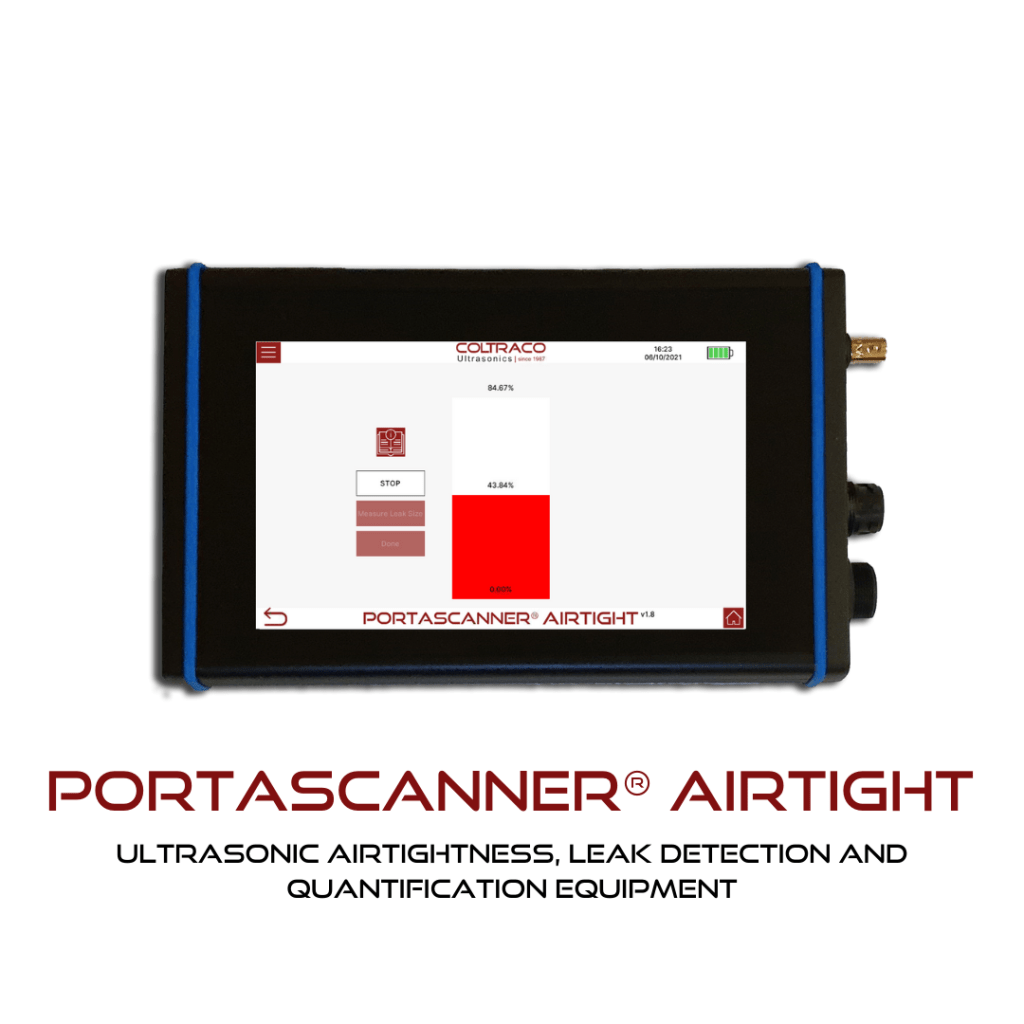
The research demonstrated that the Portascanner® AIRTIGHT can identify, quantify, and rank individual air leakage sites without requiring an imposed air-pressure differential. It can be used during construction to find and rectify individual defects and, by summing the flowrates associated with those leaks, can also provide an assessment of whole-building leakage and air permeability.
Why Air Leakage Matters for Building Performance
Air leakage occurs when air passes unintentionally into or out of a building through gaps, cracks, joints and other openings in the building envelope.
This infiltration can affect both energy use and the performance of the finished building. The research paper cites estimates suggesting that infiltration accounts for between 13% and 50% of UK domestic space heating demand, as well as around 11–15% of UK housing stock energy demand.
Improving airtightness can therefore contribute to reducing unnecessary heat loss and improving the energy and carbon performance of buildings.
A Blower Door test provides an aggregate measurement of air leakage across an enclosure. This is useful for assessing overall performance against a design target or, where applicable, demonstrating compliance with building regulations.
Locating the individual leaks behind that overall result is a different task.
Conventional methods can use supplementary equipment such as anemometers, infrared thermography and smoke pencils. Depending on the method, sufficient air movement, pressure or a temperature difference may also be needed to reveal the leakage path.
The new research examines whether ultrasound can provide another way of identifying and assessing those specific leakage points.
What Is Ultrasonic Air Leak Detection?
Ultrasonic air leak detection uses high-frequency sound to identify openings through a building element. A transmitter produces ultrasound on one side of the construction, while a directional receiver measures sound emerging through leakage paths on the other. The method does not require a pressure or temperature differential. In the study, the ultrasonic device closely quantified direct leakage holes and ranked the relative severity of indirect leakage paths.
The device assessed in the study operates at a frequency of 40 kHz.
A transmitter is positioned on one side of the construction and a hand-held directional receiver is used on the other. Solid materials reflect much of the ultrasound, while an air leakage path allows more of the signal to pass through.
The receiver measures the ultrasonic signal at the identified leak and compares it with an open-air reference value. The system then uses this information to infer the individual leakage area.
Coltraco’s Portascanner® AIRTIGHT applies this ultrasonic method to building airtightness testing, with a focus on finding and assessing individual leakage points.
Inside the New Air Leakage Testing Study
The paper, A novel approach to rapidly identifying, quantifying and ranking air leakage, was written by David Johnston, Dominic Miles-Shenton and Felix Thomas of the Leeds Sustainability Institute at Leeds Beckett University, together with Daniel Dobrowolski, Head of Research at Coltraco Limited and Director of the Durham Institute of Research, Development, and Invention.
The work was funded through the Innovate UK Net Zero Heat: Rapid assessment of building fabric performance programme. Coltraco was funded through the project to develop the ultrasonic device.
Readers can view the peer-reviewed study published in Energy & Buildings for the full methodology and results.
The first stage of testing took place in two adjacent rooms at Leeds Beckett University. A large window between the rooms was replaced with a specially constructed plywood aperture, allowing the researchers to introduce leakage holes of known size.
Initially, three technologies were assessed:
- A novel hand-held ultrasonic device
- An Energy Conservatory Duct Blaster Blower Door
- A Low-Pressure Pulse 2.0 test unit
- During the later tests, thermography was also used.
The setup allowed the researchers to investigate both straightforward direct air leakage and more complex indirect leakage paths.
Measuring Direct Air Leakage
For the direct tests, holes ranging from 2 mm to 12 mm in diameter were introduced through a single layer of plywood.
Because the geometric area of each hole was known, the researchers could compare it directly with the leakage area inferred by the ultrasonic device.
The results showed close agreement.
A 10 mm diameter hole, for example, had a true area of 79 mm². The three ultrasonic measurements were 79 mm², 78 mm² and 75 mm².
A 5 mm hole had a true area of 20 mm². The corresponding ultrasonic measurements were 19 mm², 18 mm² and 20 mm².
Across the tests, the inferred leakage measurement increased as the true hole size increased. This meant the device could also rank the known direct leakage points in size order.
The paper concludes that, under the conditions tested, the ultrasonic device was capable of both ranking these direct leaks and producing measurements that closely matched their true leakage areas.
For building professionals, the ability to distinguish between individual leakage points could provide useful information when deciding which areas should be investigated first during remedial air sealing.
Testing More Complex, Indirect Air Leakage Paths
Actual building envelopes do not consist only of simple holes through single materials.
Leakage can follow less direct routes through cavities or construction layers. To investigate this, the researchers also tested simplified indirect, or convoluted, leakage paths using two layers of plywood.
Openings of either 12 mm or 22 mm were created on the control-room side, while openings ranging from 2 mm to 12 mm were introduced on the test-room side.
The researchers suggest that the indirect path, together with frictional and viscous effects associated with the smaller openings, is likely to have restricted the movement of air and the transmission of sound.
The smaller internal opening also dominated the ultrasonic result. Changing the larger opening on the opposite side had relatively little effect compared with changing the smaller opening.
The key finding, however, was that the device could still rank the relative severity of the indirect leaks.
As the true internal hole size increased, the inferred leakage measurement also increased.
The two findings should therefore be understood separately:
- For the direct leakage holes, the ultrasonic measurements closely matched the true leakage area.
- For the indirect leakage paths, the device did not closely quantify the true geometric area but successfully ranked the leaks by relative severity.
Does Ultrasonic Air Leak Detection Replace Blower Door Testing?
Blower Door testing and Portascanner® AIRTIGHT serve different purposes within the wider airtightness testing process.
Blower Door testing is primarily used to measure aggregate air leakage across an enclosure. A fan creates a series of pressure differentials, airflow is measured, and the resulting data can be used to establish the overall air permeability of a building.
The Low-Pressure Pulse method performs a similar whole-building role, using short pulses of compressed air to pressurise the space and measure aggregate leakage.
Portascanner® AIRTIGHT focuses on a different task. Rather than measuring the total leakage rate of an enclosure, it is designed to locate, assess and rank individual leakage points.
For this type of investigation, ultrasonic testing can complement whole-building airtightness testing and, in certain applications, provide an alternative to the auxiliary leak-detection methods commonly used alongside a Blower Door test. The paper specifically identifies anemometers, infrared thermography and smoke detection as conventional methods used to find individual areas of air leakage.
The qualitative testing in the study shows this difference clearly.
When using the Blower Door method, the researchers depressurised the test room to approximately 60 Pa and used a smoke pencil to locate the known leakage points. All of the direct and indirect leaks were successfully identified.
Portascanner® AIRTIGHT also identified all of the known leakage points, but did so without requiring supplementary leak-detection equipment, a pressure differential or a temperature differential.
The technologies also calculate their measurements differently. Blower Door and LPP testing use pressure and airflow measurements to derive an Effective Leakage Area, while Portascanner® AIRTIGHT infers the area of an individual leak from the amount of ultrasound transmitted through it, with airflow estimated afterwards. The paper notes that these different measurement approaches mean their outputs are not necessarily directly comparable.
For whole-building air permeability testing and regulatory assessment, established pressure-based methods continue to perform their intended role. For finding, assessing and ranking individual leakage points, Portascanner® AIRTIGHT can be used alongside those methods and, in suitable situations, as an alternative to additional leak-location techniques.
Finding Air Leaks Before the Building Envelope Is Complete
One of the practical differences highlighted in the paper is when acoustic testing can be used.
The researchers explain that acoustic methods do not require the building envelope to be complete and are not dependent on the pressure or temperature conditions required by some conventional leakage-detection methods.
This means the approach can be used before, during or after new-build construction or refurbishment.
For a construction team, finding leakage while work is still underway could provide the opportunity to assess specific problem areas before the project reaches final whole-building testing.
Coltraco’s guide to improving building airtightness before a Blower Door test looks more closely at the role of identifying leakage before final testing takes place.
What Could This Mean for Building Airtightness Testing?
The study addresses a practical question within the airtightness process.
Whole-building testing can establish how much a building leaks.
Ultrasonic testing can help investigate where individual leaks are and how they compare with each other.
Under the controlled conditions tested, the hand-held ultrasonic device:
- Identified the known direct and indirect leakage points
- Closely quantified the direct leakage areas
- Ranked the direct leakage holes in the correct order
- Ranked the relative severity of the indirect leakage paths
- Operated independently of air movement, pressure or a temperature differential
- Could be used without requiring a complete building envelope
The authors conclude that the device can play an important complementary role in airtightness testing. They also identify the potential for the method to support improved build quality, lower remedial costs and better energy and acoustic performance.
For Coltraco, the paper provides a peer-reviewed comparative assessment of the ultrasonic measurement approach used within Portascanner® AIRTIGHT and adds to the wider research into acoustic methods for building air leakage detection.
To learn more about Coltraco’s work in ultrasonic measurement, visit About Coltraco, explore Portascanner® AIRTIGHT or contact the team to discuss the use of ultrasonic testing on an airtightness project.