
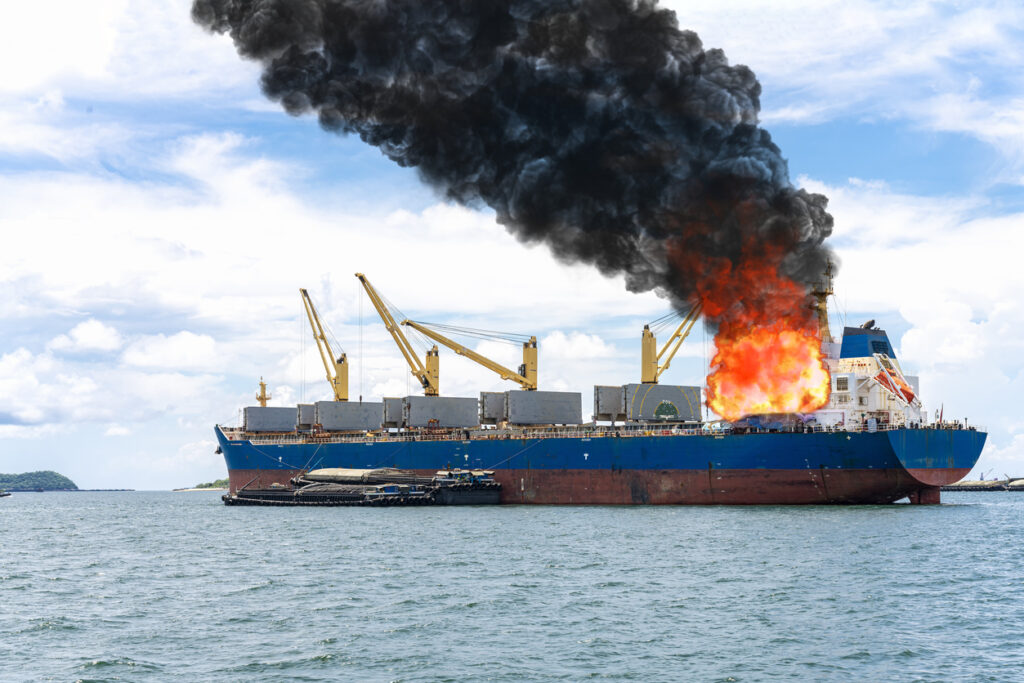
Fire remains one of the most serious risks facing ships at sea. Allianz Commercial recorded 218 fire and explosion incidents involving vessels over 100GT during 2025, making it the second-highest annual total of the past decade. For anyone responsible for fire safety on ships, those figures raise an important question: if a fire develops, is the equipment designed to protect the vessel ready when it is needed?
Prevention and early fire detection remain essential, but preparedness also depends on the condition of onboard fire suppression systems. For fixed gaseous systems, that includes knowing that cylinders contain the expected quantity of extinguishing agent before an emergency occurs.
More Than 200 Ship Fires Were Reported in 2025
The latest Allianz Commercial Safety and Shipping Review 2026 shows that shipping safety has improved in several areas. Total reported incidents fell by around 16%, from 3,353 in 2024 to 2,818 in 2025.
Fire has not followed that wider downward trend to the same extent. Allianz recorded 218 fire and explosion incidents during 2025, behind only machinery damage or failure and vessel collisions among the leading causes of reported shipping incidents.
The significance is not simply the number of fires. When a serious marine fire develops at sea, a crew cannot rely on the rapid external support available to a land-based facility. Vessel size, cargo concentration, restricted access and the distance from a suitable port can all increase the difficulty and cost of controlling an event.
Allianz also highlights the severity of fires aboard large container ships and car carriers. Crews can be forced to abandon a vessel before specialist firefighting and salvage support arrives, while losses associated with the vessel and cargo can quickly become substantial.
Why Is Fire Safety on Ships So Important?
Fire safety on ships is essential because crews may have limited external support during an emergency at sea. Effective protection combines fire prevention, early detection, containment, trained crew, firefighting equipment and maintained fire suppression systems. Fixed suppression cylinders should also be checked so operators can confirm that the expected extinguishing agent is available before a fire occurs.
No single system provides complete fire protection.
Effective vessel safety depends on several layers working together, from controlling potential ignition sources in engine rooms and machinery spaces to effective detection, alarms, crew procedures and suitable suppression equipment.
The regulatory direction reflects that need. New SOLAS requirements effective from January 2026 strengthened fire detection, alarm and monitoring arrangements for vehicle, special-category and ro-ro spaces, including provisions for continuous video monitoring.
Lithium-Ion Batteries Are Adding to Marine Fire Risk
The increasing number of lithium-ion batteries carried aboard ships is another factor changing the risk picture.
Lithium-ion technology is widely used in electric vehicles, consumer electronics and other goods transported in containers. Allianz reports that global battery deployment in 2025 was around six times the level seen five years earlier, with further growth expected towards 2030.
Damaged or defective batteries can enter thermal runaway and produce intense heat. Once involved in a fire, batteries can also present challenges around cooling, containment and re-ignition, making effective detection and firefighting planning particularly important.
The Morning Midas demonstrates the potential severity of a major vessel fire. The car carrier caught fire in the North Pacific in June 2025 and later sank. It was carrying around 3,000 vehicles, including approximately 70 fully electric and 700 hybrid vehicles. Allianz notes that these vehicles may have intensified the fire, although establishing the original cause was difficult after the vessel was lost.
That distinction matters. Lithium-ion batteries should not automatically be blamed for every ship fire involving electric vehicles. What incidents such as this demonstrate is how difficult a large onboard fire can become once it develops.
Marine Fire Suppression Systems Need Regular Attention
As fire risks become more complex, the reliability of marine fire suppression systems becomes increasingly important.
Fixed CO₂ and other gaseous systems are commonly used to protect high-risk spaces such as engine rooms and machinery spaces. Their purpose is to deliver a specified concentration of extinguishing agent when a system is discharged.
However, seeing cylinders installed does not by itself confirm how much liquefied agent remains inside them.
Cylinder contents therefore need to form part of routine inspection and maintenance. A shortfall identified during a planned test can be investigated and corrected. Discovering it during a fire event at sea is very different.
Coltraco provides further guidance on testing and monitoring marine fire suppression systems using non-invasive ultrasonic technology.
How Can Fire Suppression Cylinders Be Checked On Board Ships?
Traditionally, establishing the contents of some liquefied gaseous fire suppression cylinders can involve disconnecting and physically weighing them.
Ultrasonic liquid level detection offers another approach. Measurements are taken externally to identify the transition between the liquid and gas regions inside the cylinder.
This allows crews and service teams to establish the liquid level without opening the cylinder or disrupting the suppression installation simply to obtain that measurement.
It is important to distinguish cylinder monitoring from a complete fire suppression system inspection. Checking agent levels does not verify valves, alarms, pipework, discharge mechanisms, fire detection equipment or every other component of the installation.
Instead, it provides confidence in one critical part of the system: whether the expected suppression agent is present within the cylinder.
Monitoring Cylinders With Portalevel® MAX MARINE PLUS
Coltraco developed the Portalevel® MAX MARINE PLUS specifically for liquid-level monitoring in marine environments.
The handheld instrument uses ultrasound to monitor CO₂, Halon and core Clean Agent fire suppression cylinders from outside the cylinder. It can identify the liquid level to ±1.5mm and is designed to provide a reading in less than 30 seconds with a single operator.
For banked cylinder installations, an extension rod allows operators to reach cylinders positioned behind the front row. Because measurement is non-invasive, the suppression system does not need to be disconnected simply to establish the liquid level.
The equipment carries ABS Type Approval, RINA Classification Society Approval and UL listing for its stated applications.
For a marine operator, the benefit is practical rather than complicated: easier routine checks can help identify unexpected changes in cylinder contents before the system is called upon during an emergency.
Where the liquid-level measurement needs to be translated into agent mass, the Portasteele® CALCULATOR can be used alongside a Portalevel® unit. It calculates agent weight using the detected level, cylinder information and temperature, providing an additional record for inspection and traceability.
Fire Preparedness Cannot Be Left to Assumption
The Allianz figures show that while shipping has made progress in overall safety, fire remains a persistent threat. Larger vessels, concentrated cargo values and increasing volumes of lithium-ion batteries mean the consequences of an uncontrolled fire can be severe.
Effective fire safety on ships therefore depends on preparation before an alarm sounds. Fire prevention, detection, crew training, firefighting capability and maintained suppression systems all have a role.
Monitoring fire suppression cylinders is only one part of that picture, but it is a part that can be checked. If a vessel depends on fixed gaseous suppression during an emergency, knowing that the expected extinguishing agent is available should be based on measurement rather than assumption.