Water ingress is one of the quickest ways for cargo operations to become a costly claim. A worn seal, a damaged compression bar, or a small gap around a cargo hatch can let seawater into the cargo hold before the issue is seen.
Coltraco Ultrasonics manufactures ultrasonic hatch cover testing equipment for ship owners, surveyors, marine safety teams and fleet operators who need accurate, repeatable checks onboard. Our Portascanner® systems help crews find leaking hatch covers, confirm watertight integrity and reduce the risk of cargo damage.
If you need hatch cover testing equipment for routine inspections, ultrasonic hatch cover tightness testing, or door tightness testing, Coltraco can help you choose the right system for your vessel, fleet or survey work.
Speak to Coltraco about ultrasonic hatch cover testing equipment


We are proud winners of the Queen’s Award for Enterprise in International Trade, in both 2019 and 2022.

Hatch covers protect cargo from water ingress, spray, weather exposure and contamination during a voyage. When they fail, the result can be damaged cargo, delayed cargo operations, insurance disputes and avoidable safety risks.
Common causes of leakage include:
Traditional tests such as the chalk test, hose tests, light test and air test can support inspection, but they each have limits. They may be time consuming, weather dependent, hard to repeat, or unable to show the exact location of a leak.
Ultrasonic testing gives a clearer result. It uses ultrasonic sound to identify where air or sound waves escape through a gap in the hatch seal. This helps crews and surveyors find leaks before they allow water into the cargo hold.
Hatch cover testing is the process of checking whether a vessel’s hatch covers, cargo hatches and seals can prevent water ingress. It helps confirm weather tightness, watertight integrity and cargo safety before, during or after cargo operations.
Ultrasonic hatch cover testing uses a transmitter inside the cargo hold and a receiver outside the hatch. If ultrasonic sound escapes through the seal, the ultrasonic hatch cover tester detects the leakage point so repairs can be planned.
An ultrasonic hatch cover tester uses two main parts: a generator and a receiver.
The generator is placed inside the cargo hold. It releases ultrasonic sound waves through the air. The operator then scans around the vessel’s hatch covers, hatch coamings, seals and joints using the receiver.
If the hatch is properly sealed, little or no ultrasonic sound will pass through. If there is a leaking hatch, the receiver detects the sound escaping through the gap.
This method helps operators:
For a more detailed explanation, read Coltraco’s guide to what an ultrasonic hatch cover tester is and how it works.
Different testing methods can be used to inspect a ship’s hatches. The right method depends on the vessel, the cargo, the inspection purpose and whether the cargo is already onboard.
| Testing method | What it checks | Main limitation |
| Chalk test | Contact between the seal and compression bar | Does not prove water tightness |
| Hose test | Visible water leakage under spray | Can take several hours and depends on weather conditions |
| Light test | Obvious gaps around the hatch | Limited detail and not suitable for all inspections |
| Air test | Pressure loss or leakage | Less practical for routine hatch cover checks |
| Ultrasonic testing | Leak location and leakage severity | Requires specialist ultrasonic equipment |
Ultrasonic tightness tests are often the most practical option because they are clean, cost effective and measurable. They do not require water, they can be carried out while the cargo hold is dry, and they help operators identify the exact location of leakage.
A leaking hatch may look minor, but even a small seal failure can affect cargo safety.
Water ingress can damage bulk cargo, containers, packaged goods and sensitive materials. It can also lead to mould, corrosion, contamination, cargo rejection and claims against the vessel.
Regular hatch cover testing helps ship owners and operators:
The aim is simple: test the hatch before the leak becomes a claim.
Open Hatch Value, often called OHV, is used as a reference point in ultrasonic hatch cover testing.
The open hatch value is taken when the hatch is open. This gives the operator a baseline reading. During the test, readings taken around the closed hatch are compared against that value.
This helps the operator understand whether the leakage is minor or serious. Instead of relying on guesswork, ultrasonic technology gives a clearer reading that can be used for inspection reports, repair planning and follow-up checks.
Portascanner® WATERTIGHT PLUS is a handheld watertight integrity tester for hatch covers, watertight doors and multi cable transit seals.
It is suited to routine inspections, cargo hatch checks, planned maintenance and survey work. It helps operators detect leakage, measure results in decibels and Open Hatch Value, and inspect without the delays of hose testing.
Choose WATERTIGHT PLUS if you need a portable ultrasonic hatch cover tester for regular onboard checks.
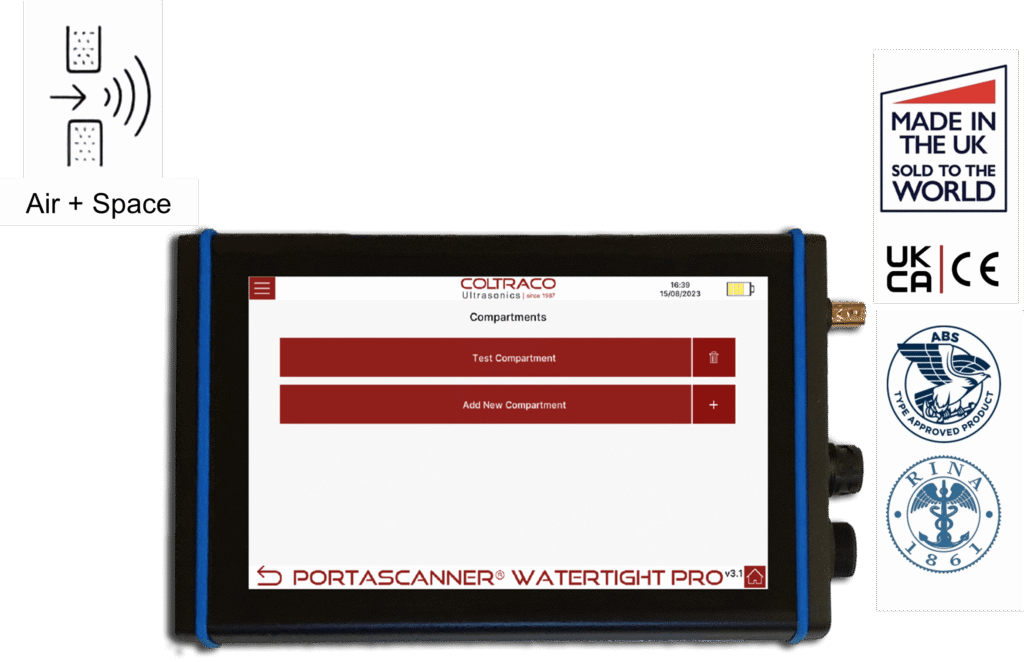
Portascanner® WATERTIGHT PRO is a handheld, tablet-based system for more detailed leak detection and reporting.
It can identify the exact location and size of multiple leaks on a single structure. It also supports electronic reporting, which helps operators record results, plan repairs and repeat inspections across several hatches or vessels.
Choose WATERTIGHT PRO if you need more detailed reporting, leak sizing and inspection records.
For routine hatch cover testing, watertight door checks and MCT inspection, Portascanner® WATERTIGHT PLUS is often the right choice.
For operators who need tablet-based reporting, leak sizing and more detailed inspection records, Portascanner® WATERTIGHT PRO may be the better fit.
If you are unsure, Coltraco can advise based on your vessel type, inspection frequency, reporting needs and the structures you need to test.
The best hatch cover testing equipment should be accurate, easy to use and suitable for real shipboard conditions.
Before choosing a system, ask:
Coltraco’s Portascanner® range is built around these practical needs. It helps ship owners, crews and surveyors move away from slow traditional methods and towards faster ultrasonic hatch cover testing.
Leaking hatch covers can put cargo, schedules and safety at risk. Coltraco Ultrasonics gives ship owners, surveyors and marine teams the equipment they need to test hatch covers, watertight doors and sealed structures with accuracy.
If you need ultrasonic hatch cover testing equipment for your vessel, fleet or inspection team, speak to Coltraco Ultrasonics today. We can help you select the right Portascanner® system for your work.