
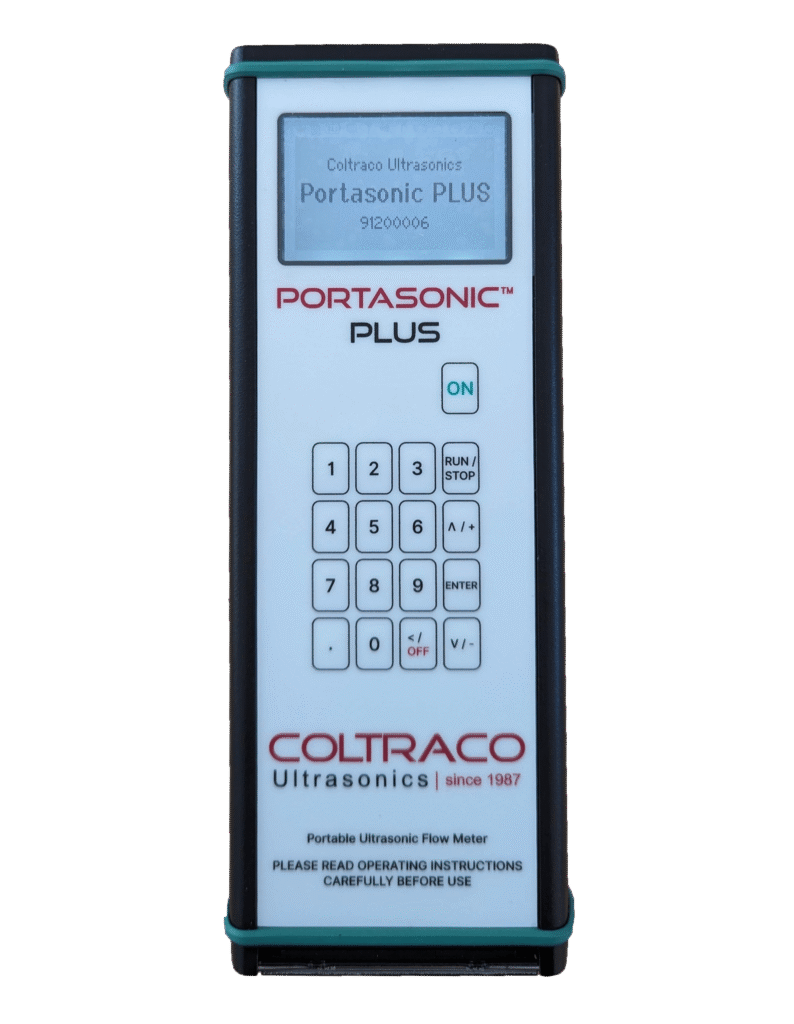
When you need to measure flow inside a pipe, the last thing you want is unnecessary downtime, pipe cutting, or added pressure loss. In many industrial, marine, and process environments, opening the system is not practical. It can interrupt operations, affect safety, and create extra maintenance work.
So, how does an ultrasonic flow meter work?
An ultrasonic flow meter uses sound waves to measure the speed of a liquid moving through a pipe. The meter sends ultrasonic pulses through the pipe wall and the flowing fluid. It then measures how those pulses change as the fluid moves. From that information, the meter calculates flow velocity and uses the pipe size to work out the flow rate.
For engineers, facilities teams and operators, this gives a practical way to check what is happening inside a piping system without stopping the process.
What Is Actually Being Measured?
An ultrasonic flow meter is not directly ‘watching’ liquid move through a pipe. It measures the behaviour of an ultrasonic signal.
That signal tells the meter how fast the fluid is moving. This is known as flow velocity.
Once the meter knows the flow velocity, it can calculate the amount of liquid or gas moving through the pipe over time.
In simple terms:
Flow rate = flow velocity × pipe cross-sectional area
This is why correct pipe data matters. If the pipe diameter, wall thickness or cross-sectional area is entered incorrectly, the volumetric flow rate can also be wrong.
How Do Ultrasonic Flow Meters Work Step by Step?
Although different ultrasonic meters use different methods, the basic process is similar.
- The ultrasonic sensor sends a signal. A transducer sends ultrasonic pulses through the pipe wall and into the flowing fluid.
- The signal travels through the fluid – The ultrasonic waves move through the liquid or gas along a known acoustic path.
- The signal is received – A second transducer receives the ultrasonic signal.
- The meter measures the difference – Depending on the technology, the meter measures either a time difference or a frequency shift.
- The meter calculates velocity – The signal behaviour is converted into fluid velocity.
- The meter calculates flow rate – Using pipe size and cross section, the device calculates volume flow or volumetric flow rate.
This is the core principle behind ultrasonic flow meter technology. Instead of using mechanical parts inside the fluid, the meter uses sound waves to infer movement.
How Does the Transit-Time Method Work?
The transit time method is one of the most widely used forms of ultrasonic flow measurement for clean fluids.
A transit-time ultrasonic flow meter normally uses two transducers. These are positioned so that ultrasonic pulses can travel both with the flow direction and in the opposite direction.
When fluid flows through the pipe, the signal travelling with the flow reaches the other transducer slightly faster. The signal travelling against the flow takes slightly longer.
That small time difference is the key measurement.
The greater the difference between the two travel times, the faster the fluid is moving. The meter uses this transit time differential to calculate flow velocity.
Why does transit time suit clean fluids?
Transit time meters need a clear acoustic path. The ultrasonic pulses must pass through the pipe wall and fluid cleanly enough for the receiving sensor to detect the signal.
That is why transit time meters are often used for:
- Clean water
- Treated water
- Oils
- Glycol mixtures
- Compatible process liquids
- Heating and cooling circuits
If the liquid contains too many air bubbles, gas bubbles or suspended solids, the sound waves may scatter. This can affect signal quality and measurement accuracy.
For equipment information, Coltraco Ultrasonics provides details on ultrasonic flow meter technology for non-invasive flow measurement applications.
How Do Doppler Ultrasonic Flow Meters Work?
Doppler ultrasonic flow meters use a different principle.
Instead of comparing the travel time of two ultrasonic pulses, a Doppler flowmeter sends sound waves into the flowing fluid and measures the reflected signal.
The signal reflects from moving particles, suspended solids, entrained particles, air bubbles or gas bubbles in the fluid. Because those reflectors are moving with the fluid, the frequency of the returning signal changes.
This change is known as the Doppler shift.
The meter measures the frequency shift and uses it to calculate fluid velocity.
When does the Doppler method work best?
The Doppler method is usually better suited to fluids that contain enough reflectors for the ultrasonic signal to bounce back.
Common examples include:
- wastewater
- slurries
- dirty liquids
- liquids with suspended solids
- liquids containing bubbles
Doppler meters may not work well with very clean liquids because there may be nothing in the fluid to reflect the ultrasonic waves clearly.
This is one of the most important differences between transit-time meters and Doppler meters. One usually needs a clean acoustic path. The other needs particles or bubbles to reflect the signal.
Transit-Time vs Doppler: Which Method Measures What?
Both methods use ultrasonic technology, but they answer the flow question in different ways:
| Method | What it measures | Best suited to | Key requirement |
| Transit time | Time difference between upstream and downstream ultrasonic pulses | Clean fluids | A clear acoustic path |
| Doppler | Frequency shift from reflected sound waves | Liquids with particles or bubbles | Suspended solids, entrained particles or bubbles |
| Clamp-on transit time | Flow through the pipe wall | Non-invasive checks on suitable pipework | Good sensor contact and pipe data |
| Doppler flow meters | Reflected ultrasonic signal | Wastewater and dirty liquid applications | Reflective particles in the fluid |
If you are asking how an ultrasonic flow meter works in practical terms, the answer depends on which method the meter uses. Transit time measures a time difference. Doppler measures a frequency difference.
How Does the Meter Turn Velocity Into Flow Rate?
This is the part many basic explanations miss.
An ultrasonic flow meter first calculates the average velocity of the fluid. But users usually need flow rate, not just velocity.
To calculate flow rate, the meter uses the pipe’s internal cross-section.
For a full pipe, the calculation is based on:
- internal pipe diameter
- cross-sectional area
- measured flow velocity
- flow direction
- signal quality
If the pipe is circular, a larger pipe will carry more fluid than a smaller pipe at the same velocity. That is why pipe data must be accurate.
For example, if two pipes have the same fluid velocity but one pipe has twice the cross-sectional area, the larger pipe will have a higher volume flow.
This is also why careful setup matters when using clamp-on ultrasonic flow meters. The meter is not only measuring sound waves. It is using the pipe and fluid data to turn those sound wave measurements into usable flow readings.
How to Use an Ultrasonic Flow Meter Correctly
A good ultrasonic flow meter can still give poor readings if it is used in the wrong place or set up with incorrect data.
Before taking measurements, check the basics.
Check the pipe
Make sure you know the pipe material, pipe size, wall thickness and lining if relevant. The pipe wall affects how ultrasonic waves pass into the fluid.
A damaged, heavily corroded or coated pipe can weaken the ultrasonic signal.
Check the fluid
Is the fluid clean, dirty, aerated or particle-heavy?
Clean fluids usually suit transit-time meters. Liquids with suspended solids or gas bubbles may be better suited to Doppler ultrasonic flow meters.
Check the sensor position
Ultrasonic transducers need correct spacing and alignment. Poor positioning can affect the acoustic path and lead to weak signal strength.
Coltraco units guide the user on where to position the sensors, helping achieve the correct spacing and alignment for a stronger acoustic path and more reliable signal.
Avoid placing sensors too close to pumps, bends, valves or restrictions if they disturb the flow profile.
Check the signal
Before relying on the output signal, check that the meter has a stable reading. Weak signal strength may suggest poor contact, wrong pipe data, unsuitable fluid conditions or incorrect sensor spacing.
Applications of Ultrasonic Flow Meters
The applications of ultrasonic flow meters are wide because the technology can measure flow without placing moving parts in the pipe.
They are commonly used in:
- water distribution and water resources
- wastewater monitoring
- process control
- marine and offshore systems
- fire protection testing
- heating and cooling systems
- fuel and oil flow checks
- pharmaceutical and chemical processes
- energy monitoring
- open channel measurement where suitable technology is used
The appeal is simple: users can measure flow while keeping the system closed. This is valuable when downtime is costly, access is limited, or contamination must be avoided.
For marine and offshore environments, Coltraco also provides maritime ultrasonic testing equipment designed for demanding operational settings.
What Affects Ultrasonic Flow Measurement Accuracy?
Ultrasonic flow measurement can support high accuracy, but it is sensitive to application conditions.
The most common accuracy factors include:
- incorrect pipe diameter
- wrong wall thickness
- poor sensor alignment
- weak acoustic coupling
- damaged or coated pipe wall
- disturbed flow profile
- nearby bends, valves or pumps
- air bubbles in clean liquid applications
- too few particles for Doppler measurement
- too many suspended solids for transit time measurement
- temperature changes
- environmental factors such as vibration or electrical noise
The best way to improve accuracy is to match the meter to the fluid and pipework. A transit-time meter and a Doppler meter are not interchangeable in every situation.
Ultrasonic Flow Meters by Coltraco Ultrasonics
An ultrasonic flow meter works by using sound waves to measure movement inside a pipe. Transit-time meters compare how long ultrasonic pulses take to travel with and against the flow.
For engineers, maintenance teams and operators, the value is practical. Ultrasonic flow measurement can help check system performance, support process control and reduce disruption when pipe cutting is not desirable.
If you are reviewing ultrasonic flow measurement for your own system,speak to Coltraco Ultrasonics for guidance on the most suitable unit for your pipework, fluid and measurement needs.
FAQs About How Ultrasonic Flow Meters Work
What is the difference between flow velocity and flow rate?
Flow velocity is the speed of the fluid. Flow rate is the amount of fluid passing through the pipe over time. Ultrasonic meters use velocity and pipe cross-sectional area to calculate volumetric flow rate.
What is the difference between transit-time and Doppler ultrasonic flow meters?
Transit-time meters compare ultrasonic pulses travelling with and against the flow. Doppler meters measure the frequency shift of sound waves reflected by moving particles or bubbles in the fluid.
What is an ultrasonic flow meter? How does it work in one sentence?
An ultrasonic flow meter works by using ultrasonic waves to measure fluid velocity, then using pipe size to calculate flow rate.